Thursday, January 16, 2014
Article from Superintendent Magazine
Here is an interesting article pertaining to sand bunkers from this month's issue of superintendent magazine. Click Here to download a viewable *PDF version of the article.

More Tree Pruning!
9th Hole Left Side (cracked limb)
 |
| Before |
 |
| After |
10th Hole Left Side (cracked limb)
 |
| After |
 |
| After |
11th Hole Left Side
 |
| After |
Tuesday, January 14, 2014
Tree Pruning
Beautiful January weather allowed us to do a bit of pruning on the 8th and 10th holes. Pruning will continue as weather allows.
 |
| Before |
 |
| During |
 |
| After |
Wednesday, January 8, 2014
Trouble Areas On the 6th and 12th Greens.

.jpg)
Two areas of major concern that we have recommended to be
addressed immediately in the spring are the front left area of the 6th green and
the front right area of the 12th green. These two areas have become persistent
year to year problem areas largely due to drainage issues created during the
previous bunker renovation. Notice in the pictures the puddles of water that
have accumulated due to poor surface drainage.
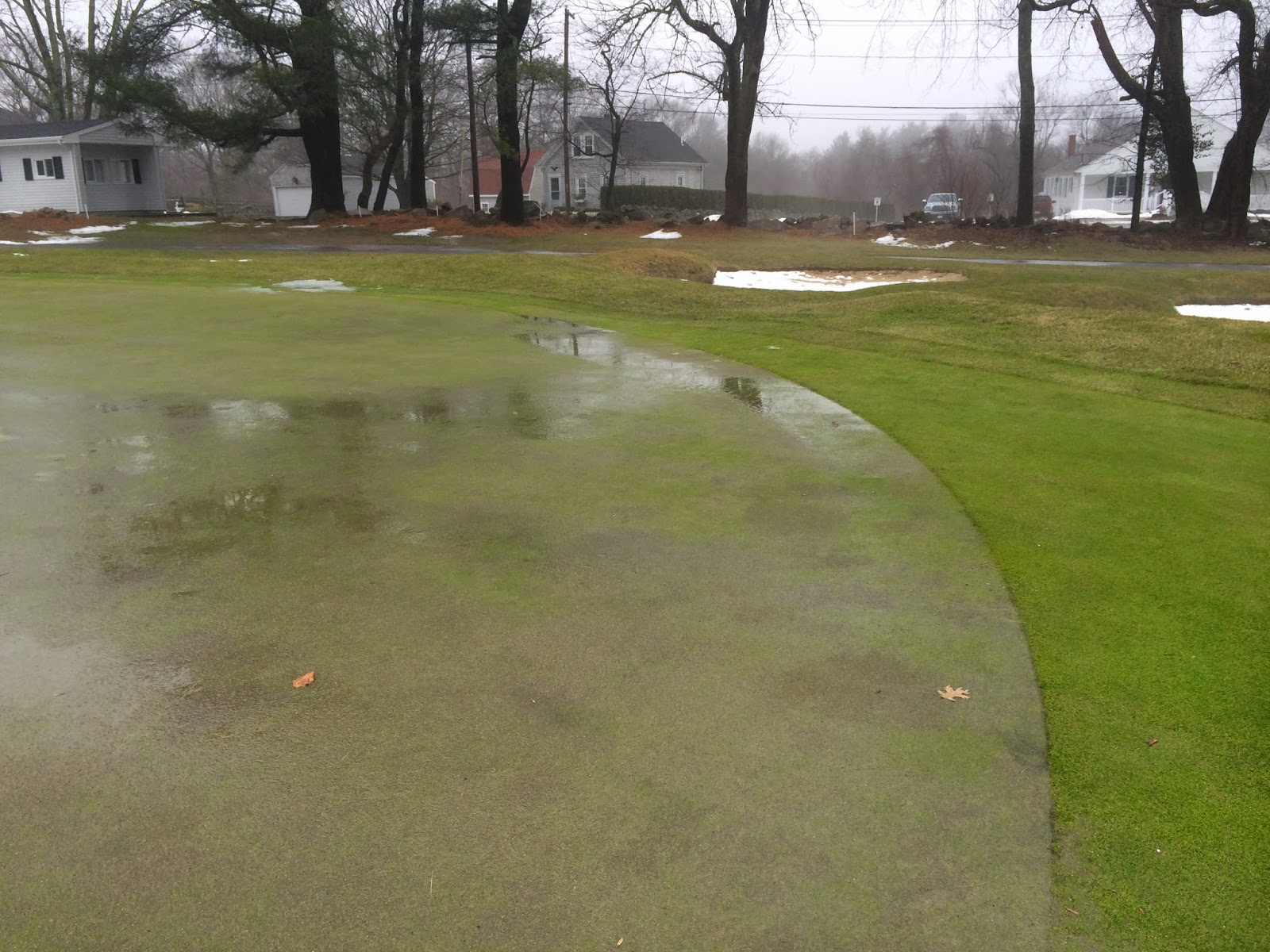 Perpetually water logged area's
significantly weaken the turf's ability to survive under the stress of summer
by making the turf more susceptible to mechanical damage from our mowing equipment,
and compromising the turf's root system by depraving it of oxygen and overly
compacting the soil. In the winter time, puddles of water from melted snow or rain
freeze and create a thick layer of ice over the turf creating anoxic conditions
(a lack of oxygen) under the ice causing the turf to begin to ferment and die.
In addition, lack of gas exchange from the ice cover causes high levels of CO2
that are toxic to the turf to build up under the ice. The
most cost effective solution would be to
strip the sod, re-grade the problem areas to allow for adequate surface
drainage, and replace the sod. This process could be completed "in-house"
using our Turf Care Maintenance Team if given approval.
Perpetually water logged area's
significantly weaken the turf's ability to survive under the stress of summer
by making the turf more susceptible to mechanical damage from our mowing equipment,
and compromising the turf's root system by depraving it of oxygen and overly
compacting the soil. In the winter time, puddles of water from melted snow or rain
freeze and create a thick layer of ice over the turf creating anoxic conditions
(a lack of oxygen) under the ice causing the turf to begin to ferment and die.
In addition, lack of gas exchange from the ice cover causes high levels of CO2
that are toxic to the turf to build up under the ice. The
most cost effective solution would be to
strip the sod, re-grade the problem areas to allow for adequate surface
drainage, and replace the sod. This process could be completed "in-house"
using our Turf Care Maintenance Team if given approval.Tuesday, November 12, 2013
Snow on November 12th...
Snow on November 12th........Thankfully it didn't accumulate much and wont be here for long!
.JPG)

Tuesday, November 5, 2013
Well Meter Testing and Certification


Each year we are required by the state to submit water usage reports and well meter certifications for each of the 7 wells that feed our irrigation system. Each year, depending on the weather, we pump anywhere from 10 to 20 million gallons of water out of our 7 wells combined for irrigation purposes. Part of the yearly re-certification process for the wells involves hiring a licensed company to come in and test / certify the accuracy of the 7 well meters that measure the volume of water we pump from each individual well.
"Blowing Out" the Irrigation System
 |
| Air Compressor attached to the irrigation system |
As anyone with an irrigation system at home knows, "blowing"
the water out of irrigation lines before winter is of the utmost
importance. Usually this is achieved by hooking an air compressor up to the
irrigation system at its source and using compressed air to pressurize the
irrigation lines and force the water
in
the lines out through the sprinklers or any other open valve. The same concept applies on the golf course
but on a much larger scale. Obviously, as water freezes it also expands. If
enough water is left inside of an irrigation line, sprinkler, valve, or any
other sensitive component, when it freezes it will expand and cause serious damage
to the irrigation system in the form of shattered pipes, broken valves, and
cracked sprinklers. |
| Sprinklers "blowing" compressed air |
I'm
sure you can imagine that it takes a rather large air-compressor to "blow
out" the irrigation system here at CCNB. The entire process takes roughly
8 hours and involves turning on each and every one of the 650 plus sprinkler
heads on the golf course in small groups until all of the water is blown out of
the system and only compressed air is coming out of the sprinklers.
 |
| Air Compressor |
Subscribe to:
Posts (Atom)